
More complete Last Free Day data, from terminals, carriers, and rail
Every container has a Last Free Day, but the terminal, the carrier, and the rail provider do not always agree on what it is. That date decides how long you have to pick up a container before demurrage charges begin, so a disagreement is not a small thing.
Which date do you trust when the terminal says one thing and the carrier says another? How do you know a rail deadline is coming if only the terminal date is on your screen?
Terminal49 now gives you a more complete view. In addition to the Last Free Day data already coming from many terminals, carrier-provided Last Free Days appear for more containers, and inland rail LFD coverage is better too.
To make this richer data easier to use, the source-specific LFD columns have been consolidated into two: POD LFD for the port and IND LFD for the inland destination. And for the times when the carrier has not published a date yet, there is a new optional Estimated LFD.
Every source, side by side
A terminal, carrier, and rail provider may each publish a different Last Free Day for the same container. Seeing each available source helps your team spot the earliest date, investigate differences, and reduce the risk of unexpected demurrage.
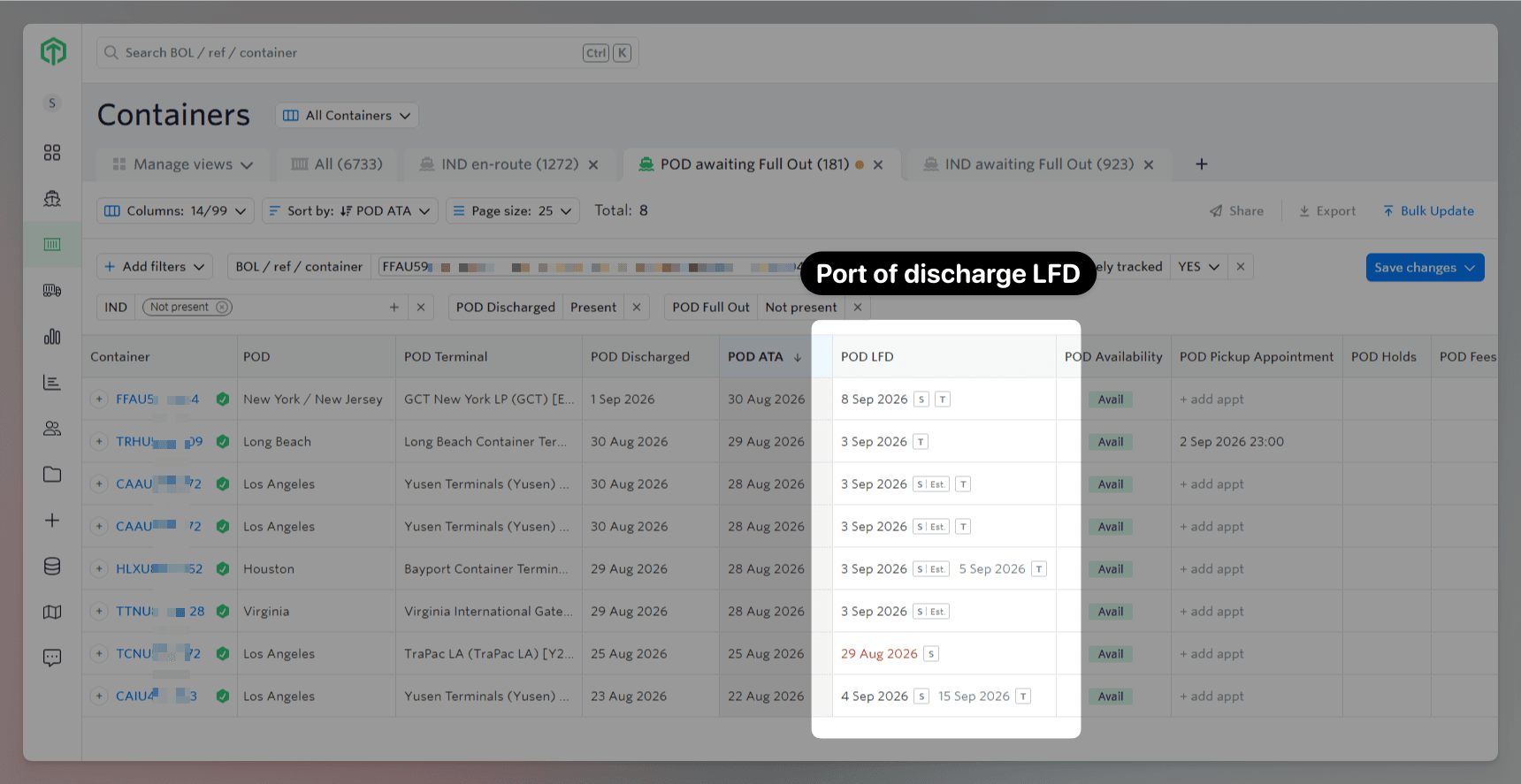
Every date is labelled with its source:
- S: carrier (shipping line)
- T: terminal
- R: rail provider
When multiple dates are available, the earliest one is shown first. Click any date to see the full source details. Carriers that generally provide LFD for containers include Yang Ming, OOCL, Evergreen, Hyundai Marine, and ONE.
Two columns, organized by where the deadline applies
Instead of spreading this data across several source-specific columns, it is organized by where the deadline applies:
- POD LFD shows Last Free Days at the port of discharge.
- IND LFD shows Last Free Days at the inland destination.
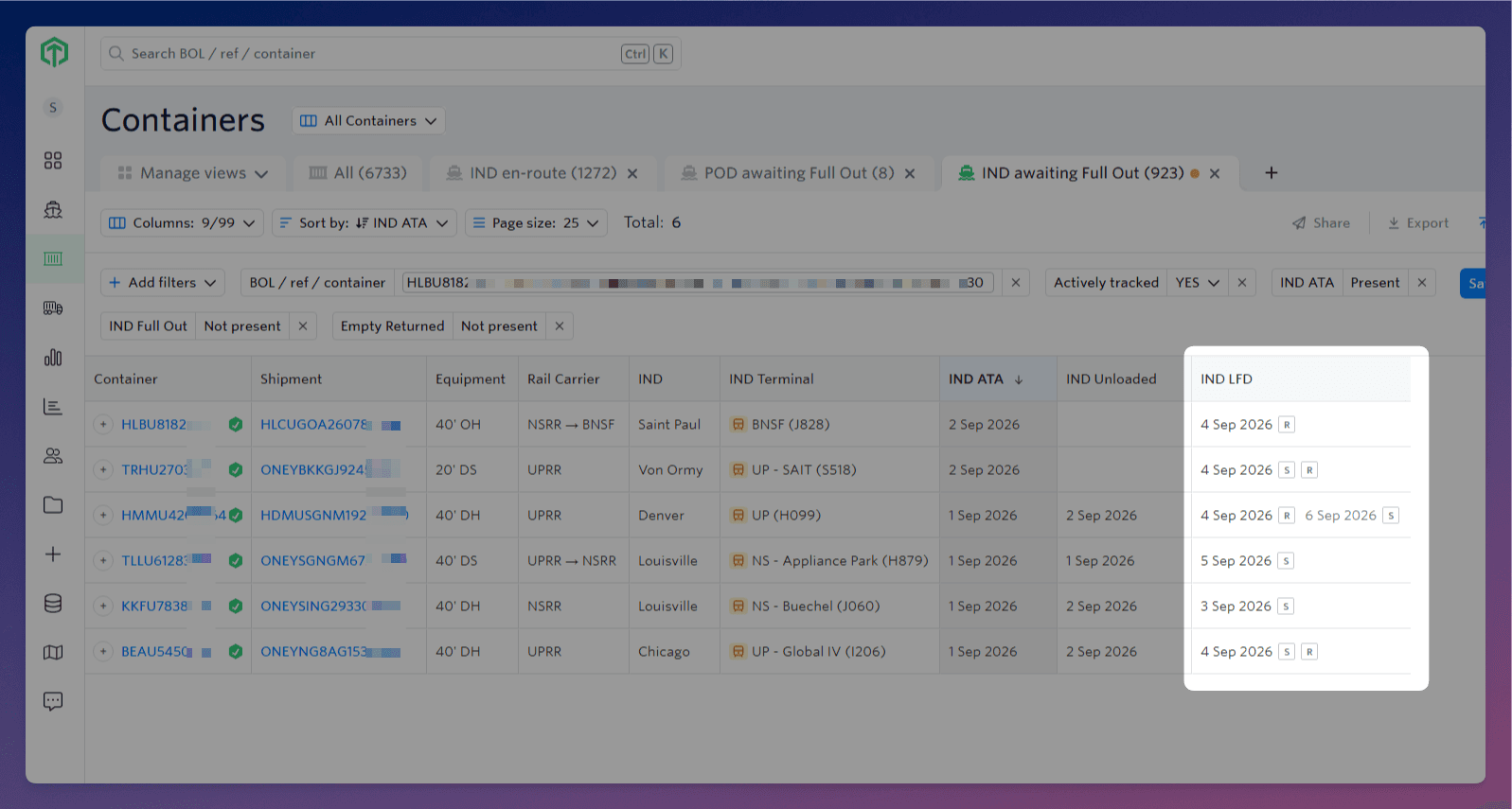
Each column can contain dates from multiple sources, clearly labelled as carrier, terminal or rail.
| Previous column | Where it lives now |
|---|---|
| LFD (combined) | POD LFD: deadlines at the port of discharge |
| Rail LFD | IND LFD: deadlines at the inland destination |
| Terminal LFD, SSL LFD, IND Shipping Line LFD | Retired as separate columns. Their dates appear in POD LFD or IND LFD with a source label. |
One thing to check: if a saved view still references Terminal LFD, SSL LFD or IND Shipping Line LFD, add POD LFD or IND LFD to that view instead. Everything else carries over automatically.
Estimated LFD, when the carrier has not published one
Carriers do not always publish a last free day, and when they do it can arrive late. When a carrier has not published a date yet, Terminal49 can now work one out from that carrier's standard free time and when the container was discharged.
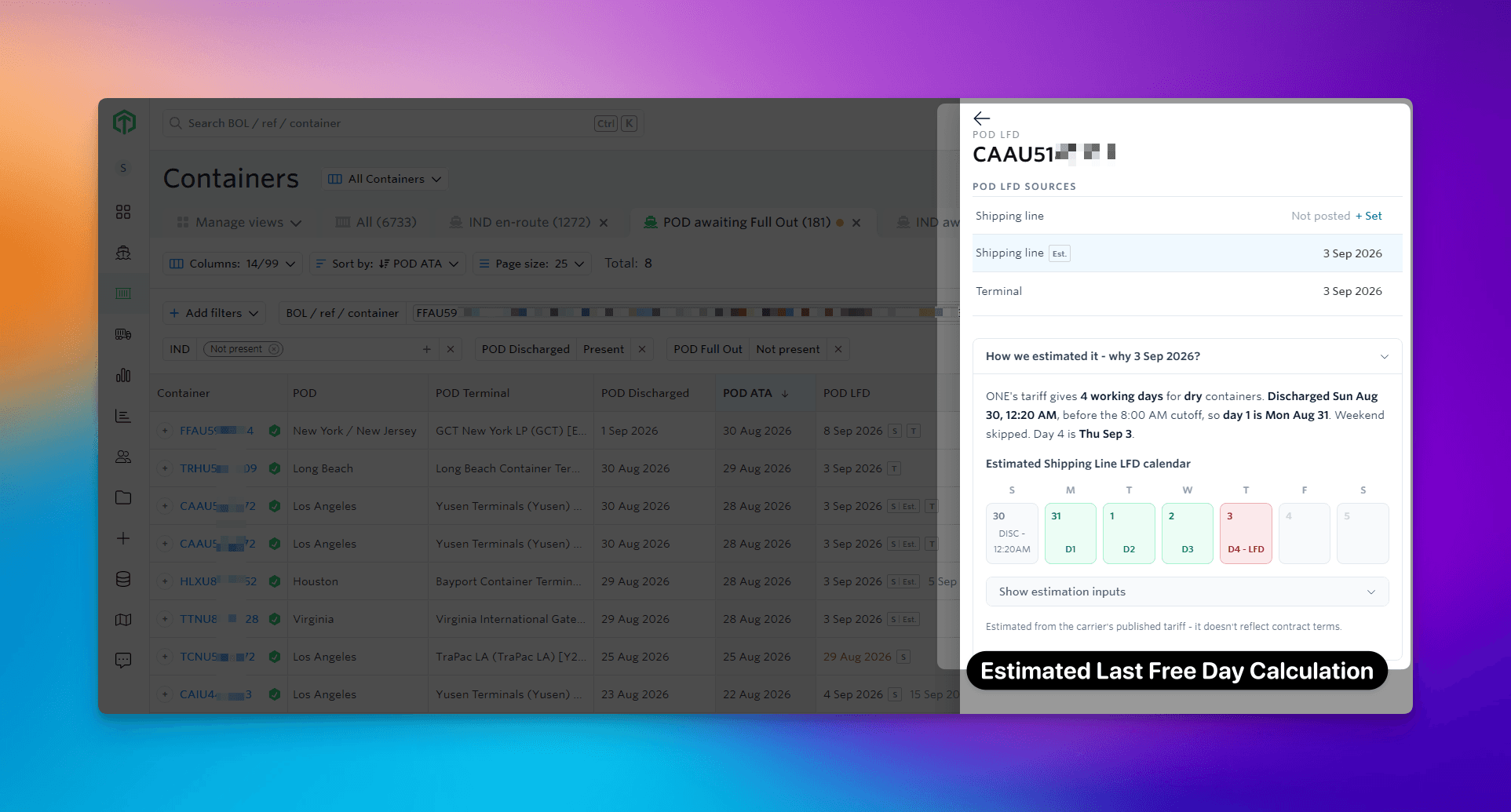
How estimates behave:
- Estimates are always marked Est. An estimate is never shown as something the carrier told us.
- The moment the carrier publishes its real date, that replaces the estimate.
- Estimates use each carrier's standard free days. If you have negotiated free time with a carrier, the estimate may not match your contract. Send your terms to support@terminal49.com so we can learn how to support them.
Availability
- The POD LFD and IND LFD columns, source labels, and expanded carrier and rail coverage are on for every account.
- Estimated LFD is in early access and off by default. An account admin can turn it on in Settings → Estimated LFD, for all supported carriers or only the ones you pick.
- Estimated LFD currently covers six carriers: CMA CGM, Evergreen, Hapag-Lloyd, Maersk, MSC and ONE.
For API users
Nothing you rely on today changes. Existing fields and webhook events keep their shape and their values. Turning on estimates adds a pod block inside import_deadlines with the per-source detail, plus a container.pickup_lfd_line_calculated.changed webhook event for the estimate itself. Both are additions; you can ignore them until you want them.
