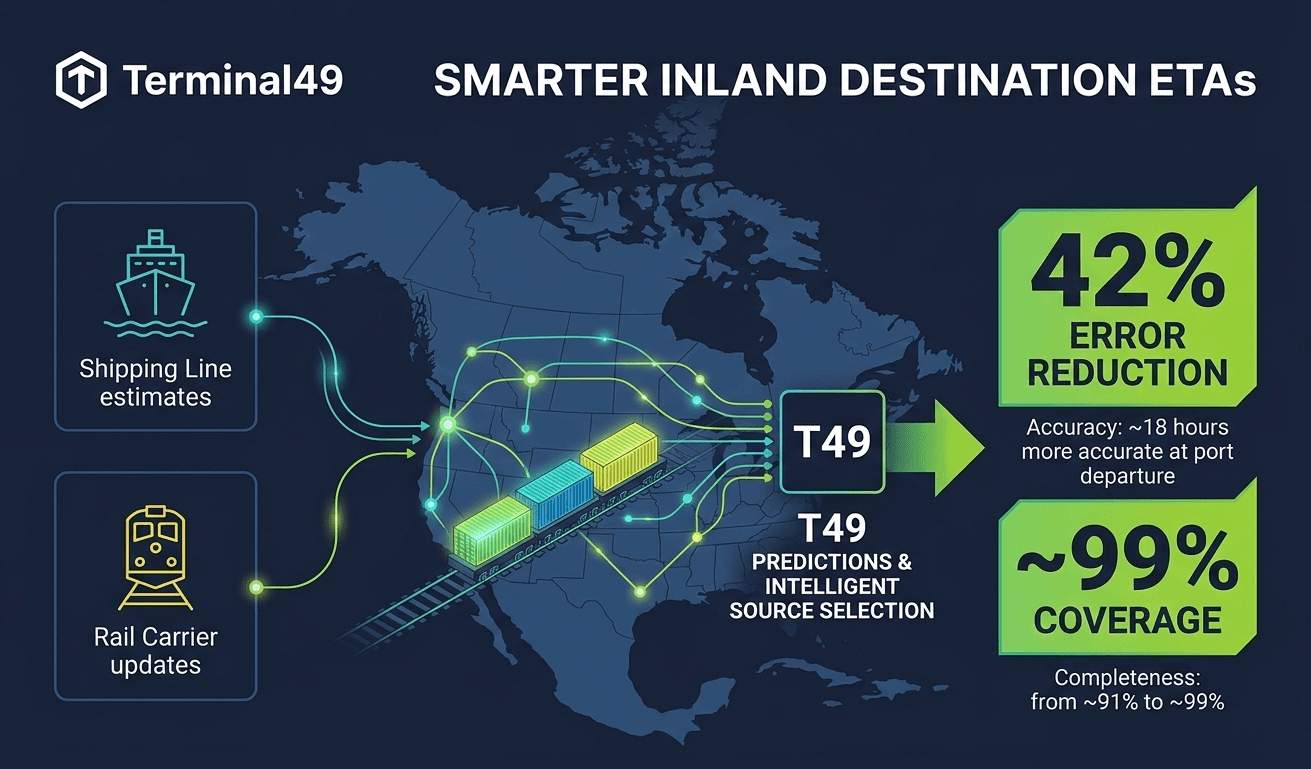
The challenge: incomplete and inaccurate inland ETAs
When a container leaves the port of discharge on rail, knowing when it will actually arrive at its inland destination is critical for drayage planning. Until now, shippers and logistics teams relied on two sources for this estimate: the shipping line's ETA and the rail carrier's ETA.
Both have significant gaps:
- Shipping line ETAs are available for only 86% of containers at the time of rail departure from the port, and their average error is 2 days.
- Rail carrier ETAs are much more accurate (~1.0 day error), but only available for 39% of containers at that point — rail data often arrives late.
- Combined, rail + shipping line provide coverage for about 91% of containers — leaving nearly 1 in 10 with no inland ETA at all after port departure.
What we built
Terminal49 now provides two new capabilities for containers moving by rail to inland destinations across the US and Canada:
1. T49 Inland Destination ETAs. Our machine learning model generates a predicted arrival time for every container as soon as it departs the port on rail. This brings coverage from 91% to ~99% — nearly every container gets an ETA at port departure, even when neither the shipping line nor the rail carrier has provided one yet.
2. Intelligent ETA source selection. Multiple ETA sources arrive over time — our T49 prediction, rail carrier updates, and shipping line estimates. Rather than simply using the most recent estimate, our ML-based source selection model evaluates all available ETAs and promotes the one most likely to be accurate. As the container moves closer to its destination and more data arrives, the model continuously re-evaluates.
The results
We evaluated performance on over 2,000 arrived containers:
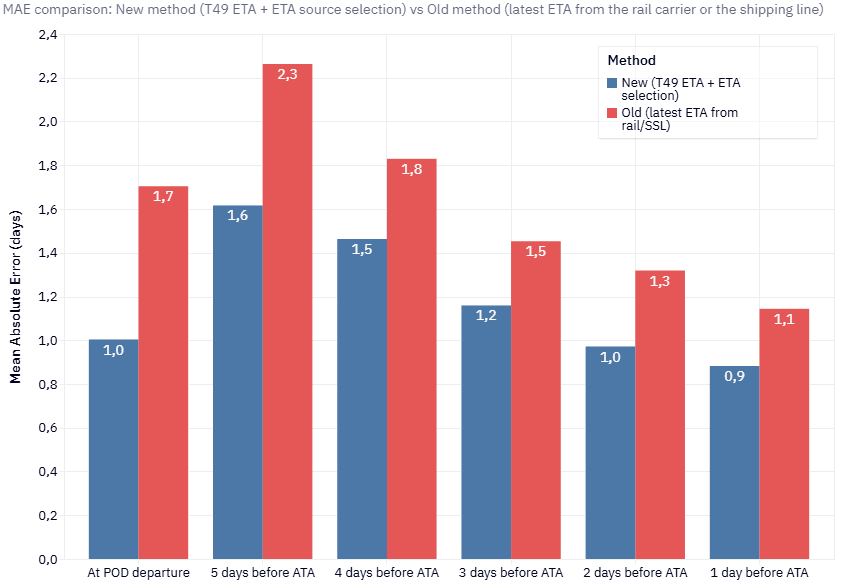
Mean Absolute Error comparison : New method (T49 ETA + ETA source selection) vs Old method (latest ETA from the rail carrier or the shipping line)
Accuracy: ~18 hours more accurate at port departure. Our new method achieves a mean absolute error of 1.00 day, compared to 1.72 days with the previous approach (latest rail or shipping line ETA). That's a 41% reduction in error — roughly 18 fewer hours of uncertainty for drayage planning.
| Metric | Old method | New method | Improvement |
|---|---|---|---|
| MAE at Port departure | 1.72 days | 1.00 days | -0.72 days (42%) |
| MAE at 1 day before arrival | 1.14 days | 0.88 days | -0.26 days (23%) |
| Coverage at POD departure | ~91% | ~99% | +8 pp |
Completeness: from ~91% to ~99%. About 9% of containers previously had no inland ETA at the time of port departure. Our T49 prediction engine now fills nearly all of that gap.
How our ETA compares to the shipping line’s
At the time of port departure, our T49 prediction is on par with rail carrier ETAs in terms of accuracy. As the container gets closer to its destination, the rail carrier's ETAs gradually improve — which is expected, since the rail carrier has real-time operational data on train movements.
That's precisely why our source selection model exists: it lets us leverage the rail carrier's improving accuracy when it becomes available, while relying on our own prediction early on when rail data is sparse. The best of both worlds.
Shipping line ETAs, by contrast, lag behind at every stage — averaging over 2 days of error regardless of how close the container is to arrival.
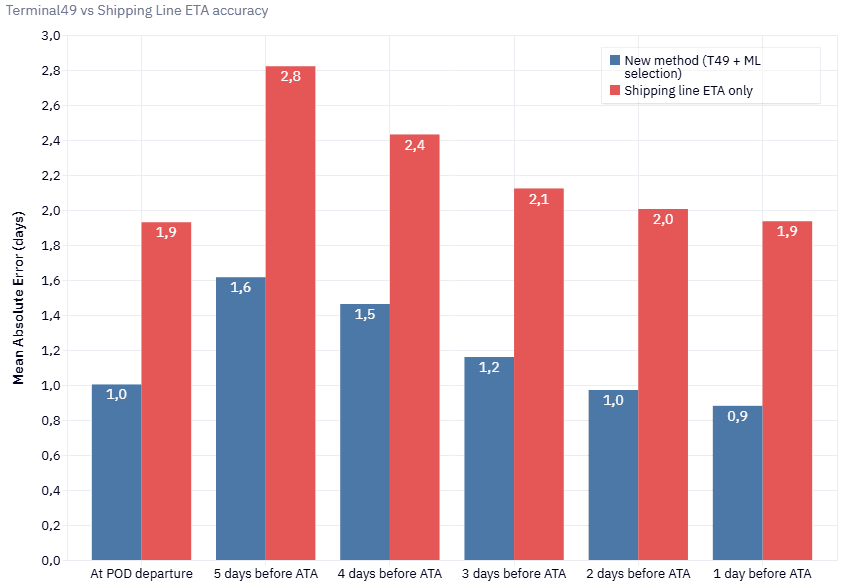
Terminal49 ETA vs Shipping LInes' ETA
Compared to shipping line ETAs alone: if customers relied solely on the shipping line, they'd have an ETA for just 86% of containers, with an average error of 2 days. Our system provides ETAs for ~99% of containers with an average error of just 1 day.
Availability
These improvements are now live for all Terminal49 rail customers tracking rail shipments to inland destinations in the US and Canada. Every container departing a port of discharge on rail now benefits from our T49 predictions and intelligent ETA source selection.
Key Takeaways
- Reduce ETA uncertainty by 42% and boost coverage to 99% with Terminal49's new inland ETA predictions for rail containers.
- Rely on accurate inland ETAs at port departure, even when rail or shipping line estimates are missing or delayed.
- Leverage intelligent source selection that automatically promotes the most reliable inland ETA as new data arrives.
- Improve drayage planning with near real-time, continuously updated arrival predictions for every inland-bound container.
- Access these enhancements immediately if you're a Terminal49 rail customer in the US or Canada.